
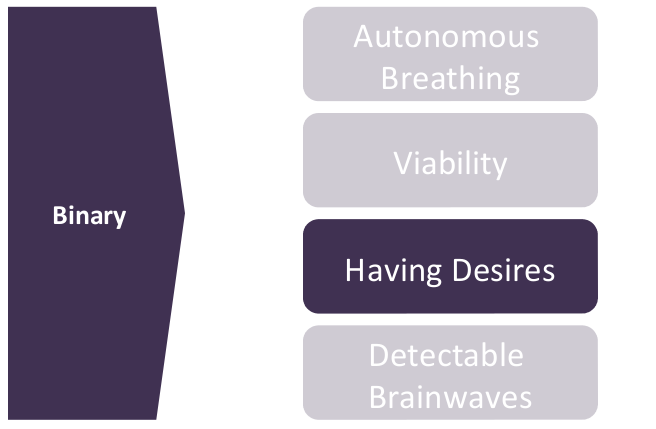
2a: Having Desires
The ability1 to form conscious desires is offered by some
philosophers as a criterion for personhood. This can be defined
in various ways, but it is hard to ascribe conscious desires to
newborn infants. Insofar as this is the case, the position fails by
excluding born babies and young children from personhood. If
possessing desires is defined broadly enough to include
newborns, then there is no reason to exclude older fetuses,
whose cognitive abilities are commensurate with newborns.
Indeed, the most that can be said for newborns is that they
 possess clear interests and are internally motivated to achieve
them, and, by this standard, even zygotes have desires.
possess clear interests and are internally motivated to achieve
them, and, by this standard, even zygotes have desires.
In short, there is no clear threshold when the developing human first begins to exhibit desires, broadly defined. If one restricts the term to those that involve self-awareness, then the threshold would still be difficult to pinpoint exactly. No matter when one claims that this ability develops, however, newborns infants would certainly be excluded.
-
Discussion Tip
Defending Premise 2a is a component of Discussion Task 2. ↩