
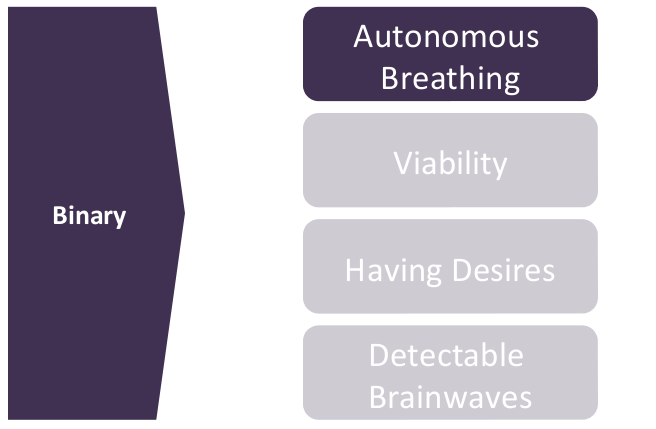
2a: Autonomous Breathing
Using breathing—engaging1 in gas-exchange via the lungs—as a criterion for personhood would place the beginning boundary of personhood at birth. Indeed, this is the most compelling way to locate the boundary precisely at birth, the current position of the U.S. legal system. While birth is certainly a dramatic event, the most dramatic change involved is in the baby’s environment, an external condition irrelevant to intrinsic value. The change in dependence is much less dramatic. The fetus was engaging in gas exchange before birth, just without the mechanical activation of the lungs. While birth marks a non-trivial increase in the baby’s independence, inasmuch as a key bodily function—gas exchange—is no longer mediated through an adult, it is hard to call that increase profound. It is still a stretch to claim that this step, developmentally significant though it may be, comprises the gulf that separates non-person from person. This is especially true since a newborn remains utterly dependent in so many other respects.
Even if one makes this claim, one runs afoul of a second, more serious problem. Elderly people become increasingly dependent as they age, often reaching levels of dependency not unlike that of a fetus. They are even put on artificial respirators when, like fetuses, they cannot mediate gas exchange by themselves. But they do not cease to be persons because of it. If a pro-choicer defines the beginning of personhood as the crossing of a certain threshold of independence, then he would have to say that one loses one’s personhood when one drops below that level, and this does not occur. Clearly, to be breathing autonomously cannot be a necessary condition for personhood. As a result, birth must not be the beginning boundary.
-
Discussion Tip
Defending Premise 2a is a component of Discussion Task 2. ↩