
Defending Premise 2b1
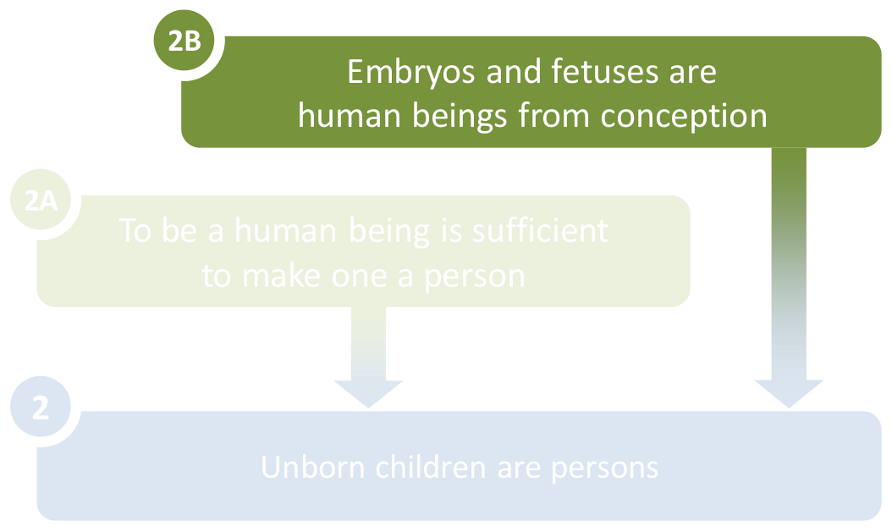
Still, Premise 2b really is the underlying point of disagreement with many pro-choice people, so you have to be prepared to discuss it. A detailed knowledge of the science of embryology, as well as the ability to rattle philosophical definitions2 off the top of your head, can certainly help.
This is not a science lesson, though, and we don’t expect our readers to become expert embryologists overnight. So we have included in the Resources section a catalogue of quotes from mainstream medical textbooks illustrating that this point isn’t—or shouldn’t be—a matter of controversy anymore.
Finally, there are a few tricks for communicating the gist of the Premise 2b argument without getting bogged down in high-brow science and philosophy. People have an intuitive understanding of what it means to be an “individual member of the species,” and often their difficulty is that a fetus seems not to be its own individual. You could delve into the detailed science of genetics, but you can also employ a simple reductio ad absursdam argument. If a fetus is not its own individual, then it must be part of the mother. If that were true, a pregnant mother would have four ears, two hearts, and, potentially, a complete package of male sex organs. Most people agree that that’s absurd.
Perhaps you are trying to explain the continuity of the
developmental trajectory beginning at conception, and the
other person responds, “It’s completely arbitrary to say it begins
there.” You could get bogged down in the philosophy of what it
means to be an organism. Or you can take advantage of the
 fact that everyone intuitively recognizes a shared identity with
earlier developmental forms. Even though none of us
remembers being an infant, we still feel a sense of shared
identity with the infant stage of our development. We can say
things like, “Back when I was a baby,” and it makes sense. The
same is true of pre-births—but not pre-fertilization—forms.
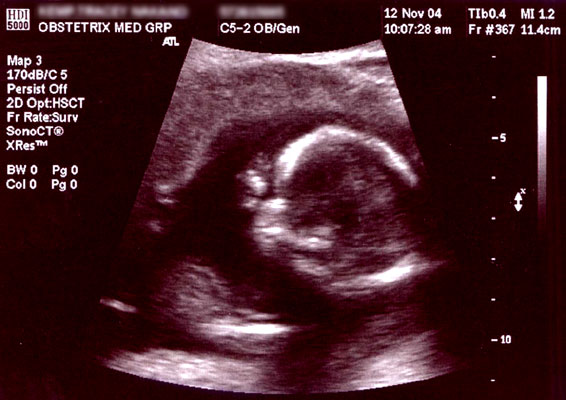
You don’t have to be pro-life to look at an old ultrasound print-out
and say, “Look, there I am.” Even people who think fetuses
are definitely non-persons will say things like, “The reason I
have this medical condition is because my mother drank alcohol
when I was in utero.” However, no one would ever say, “Back
when I was a sperm and egg, half in my mom’s ovary and half in
my dad’s testicle.” We have an intuitive sense that one makes
sense and the other doesn’t. And that intuition maps exactly
onto what we mean by a continuity of developmental
trajectory, revealing that the distinction we’re making between
non-organism and organism, far from being arbitrary, is
grounded in something very real and philosophically
meaningful.
fact that everyone intuitively recognizes a shared identity with
earlier developmental forms. Even though none of us
remembers being an infant, we still feel a sense of shared
identity with the infant stage of our development. We can say
things like, “Back when I was a baby,” and it makes sense. The
same is true of pre-births—but not pre-fertilization—forms.
You don’t have to be pro-life to look at an old ultrasound print-out
and say, “Look, there I am.” Even people who think fetuses
are definitely non-persons will say things like, “The reason I
have this medical condition is because my mother drank alcohol
when I was in utero.” However, no one would ever say, “Back
when I was a sperm and egg, half in my mom’s ovary and half in
my dad’s testicle.” We have an intuitive sense that one makes
sense and the other doesn’t. And that intuition maps exactly
onto what we mean by a continuity of developmental
trajectory, revealing that the distinction we’re making between
non-organism and organism, far from being arbitrary, is
grounded in something very real and philosophically
meaningful.
-
Reasoning Reminder
Task 2 involves defending Premise 2—that unborn children ought to be considered persons. ↩
-
Reasoning Reminder
See the Pro-Life Reasoning module for helpful philosophical definitions. ↩